Federal Grant Information
Infrastructure Investment and Jobs Act (IIJA) Competitive Grants
The Infrastructure Investment and Jobs Act (IIJA) (Public Law No: 117-58), also known as the Bipartisan Infrastructure Law (BIL), signed into law on November 15, 2021, is a $1.2 trillion investment in our nation’s infrastructure intended to rebuild America’s roads, bridges and rails, upgrade and expand public transit, modernize the nation’s ports and airports, improve safety, address the climate crisis, advance environmental justice, and invest in communities that have too often been left behind.
The BIL includes five-year reauthorization (FY22-26) of surface transportation programs and direct advanced appropriations. Total transportation funding in this five-year package is over $660 billion. As of November 2022, over $2.6 billion in Bipartisan Infrastructure Law funding has been announced and is headed to Maryland with over 35 specific projects identified for funding. Maryland is set to receive over $2.2 billion for transportation to invest in roads, bridges, public transit, ports and airports.
In order to provide stakeholders with more visibility into upcoming federal opportunities, MDOT is publishing a list of IIJA grants. This list is not comprehensive and will be updated periodically with new programs and dates. New programs are at varies stages of development. A Notice of Funding Opportunity (NOFO) is released by a federal agency to announce program specific funding availability. Applicants should consult program-specific guidance in the NOFO.
How Can a You Prepare for IIJA Opportunities?
IIJA creates new competitive grants and expands existing programs. Each will have specific selection criteria, eligibility, and geographic distribution requirements. Grant opportunities are offered annually and can be awarded on a one-time basis over one year or for a project over multiple years These grants are unique to each round of funding authorization.
It is important to identify priorities and key projects for your community, transportation or otherwise. Determine how additional grant funding can help achieve your goals and explore the wide range of available grants to determine which align with your priorities and aspirations.
Review the IIJA Guidebook to identify potential grant avenues to pursue. When you have found a grant that you wish to apply for, evaluate your internal capacity to apply and your ability to manage projects when successful identifying key staff and available resources will help make the most of your effort. Finally, pursue partnerships; collaboration is essential and MDOT is here to help. Every Competitive Grant program is unique. Look to your priorities and tailor each application to match the policy intent, desired outcomes, and specific requirements.
Interactive Map
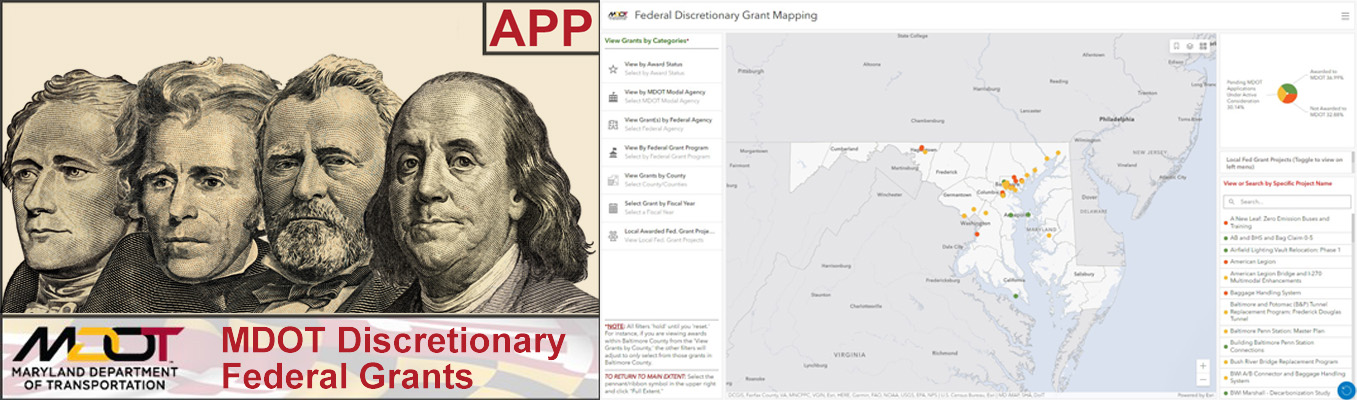
MDOT has created a Federal Discretionary Grants Interactive Map Application in which you can view/query and research MDOT Federal Discretionary Grants in an interactive, mapping interface:
Open Federal Discretionary Grants
- FTA: Bus Safety, Accessibility, and Innovation Research Program – The Federal Transit Administration (FTA) has announced the FY 2026 Bus Safety, Accessibility, and Innovation Research Program, making $10 million in competitive funding available for research, demonstration, and innovation projects that improve the safety, accessibility, and performance of public transit bus systems. The program supports initiatives that develop and evaluate new technologies, operational practices, and other innovative approaches that can enhance transit service and improve the rider experience. For FY 2026, complete proposals must be submitted through Grants.gov on September 28, 2026.
- FHWA: PROTECT Competitive Grant Program – The Federal Highway Administration (FHWA) is accepting applications for the Fiscal Years 2024 through 2026 Promoting Resilient Operations for Transformative, Efficient, and Cost-saving Transportation (PROTECT) Competitive Grant Program. The program makes up to $787 million available to help communities strengthen surface transportation infrastructure against current and future weather events, natural disasters, and changing conditions such as flooding, severe storms, extreme temperatures, sea level rise, and other hazards. Funding is available through four categories: Planning Grants, Resilience Improvement Grants, Community Resilience and Evacuation Route Grants, and At-Risk Coastal Infrastructure Grants. Through these investments, the program aims to improve the resilience of highways, public transportation, ports, and intercity passenger rail while supporting continued operations and faster recovery following disruptive events. Applications are due October 9, 2026.
- FAA: FAA Contract Tower (FCT) Competitive Grant Program – The Federal Aviation Administration (FAA) announced up to $100 million in Fiscal Year 2027 funding for improvements to airport-owned air traffic control towers. Eligible projects may include construction, repair, rehabilitation, modernization, replacement, or relocation of non-approach control towers, along with the installation of air traffic control and communications equipment. Funding may also be used for FAA-certified digital tower projects. Established under the Infrastructure Investment and Jobs Act (IIJA), the program focuses on addressing aging tower infrastructure and improving the safety, efficiency, and reliability of air traffic control services. The Federal share is 100%, with no local match required. Applications are due October 19, 2026.
- EDA: Public Works and Economic Adjustment Assistance Program – This program provides competitive funding to support infrastructure, workforce, and economic recovery projects in distressed communities. Eligible activities include public works construction, broadband and utilities, workforce facilities, business incubators, revolving loan funds, and economic development planning aligned with a regional CEDS. Eligible applicants include states, local governments, Tribes, nonprofits, economic development organizations, and public-private partnerships. Applications are accepted on a rolling basis, with cost share required.
Other Federal Discretionary Grants
How Can Maryland DOT Help?
We can work with you on state projects if they are your local priorities, partner when feasible, provide a state match if state priority, give technical support, and other assistance.
If you are representing a local entity and interested in receiving a letter of support from MDOT for current or anticipated project, please fill out this request. We will need at least (two) full weeks upon receiving the information to route for signature.
Factors for Success:
The strongest applications will have a thorough understanding of grant requirements, including deadlines, eligible costs, the application process, overall intent, duration of grant funding, design and environmental review requirements, and local funding match requirements.
This includes a solid understanding of the grant itself, and how it pertains to one of the key focus areas for transportation under this legislation (Safety, , Environmental Sustainability, Quality of Life, Economic Competitiveness, State of Good Repair, and System Modernization). Make your strongest argument possible, backed up by clear information, sound data, and broad community support at all governing and geographic levels with letters of support from partners. Additional factors to take into consideration are:
- Most grant programs involve a match or “cost share” meaning that a portion of the project’s cost must be met with non-federal sources. Typically, the match requirement is 20%, but there are some opportunities to secure 100% federal funding awards. The required match percentage, sources of match, and other requirements vary from program to program.
- The Build America Bureau, responsible for supporting transportation infrastructure development projects and offers several programs to provide project finance assistance to State, local, and private project sponsors. These are customizable credit instruments that reduce project costs and increase flexibility.
- Identify possible partnerships early in the application process. Partnering with local or state entities can increase the knowledge and resources available to enhance grant applications, ultimately giving proposals a more competitive edge.
- Encourage letters of support from state or local entities. A letter can be a valuable tool to support your grant application that helps the awarding agency determine if the proposal is worthy of funding.
- Be aware of Build America, Buy America which requires the use of materials produced in the United States, increase the requirement for American-made content, and strengthens the waiver process associated with Buy American provisions.
- Almost all of US DOT grant applications must be submitted through the Grants.gov portal. Registering is a one-time process; however, processing delays may occur, and it can take up to several weeks for first-time registrants to receive confirmation and a user password. Start the registration process as early as possible.
- All applicants must have a Unique Entity Identifier (UEI) as generated by www.SAM.gov to apply for a federal grant. Note that this can take a few weeks to process
Resources:
For more information on specific grant funding opportunities and program details, please visit the following pages:
TIP/STIP Amendment Resources:
The Maryland Department of Transportation (MDOT) wants to help you with your TIP/STIP Amendment(s). Please find below a link to our TIP/STIP Process Overview Webinar held on November 21, 2024. Other resources can also be found below:
If you have any questions or need further assistance, please contact us at [email protected].
MDOT's EV Charger Siting Tool & Installation Partnering Form
MDOT has announced the Maryland Electric Vehicle (EV) Infrastructure Installation Partnering Form, now available through the EV Plan website. The form is a new resource to encourage potential partnership and collaboration among organizations that are interested in installing publicly available EV charging stations throughout the State. The ‘List of Partners’ gathered through the form will be updated regularly so that interested organizations can reach out directly to those identified on the list about teaming opportunities. For those interested in partnering with a site host, MDOT recommends utilizing the Charger Siting Tool to determine if sites may be a good candidate.
Uniform Grants Guidance 2024 Revisions
The EPA has adopted the Office of Management and Budget (OMB) Uniform Administrative Requirements, Cost Principles, and Audit Requirements for Federal Awards to Non-Federal Entities guidance, which is commonly known as the Uniform Grant Guidance (UGG). Key changes made to the UGG through its 2024 revision, webinars, resources and contracts are available here.
Clean Cities and Communities: Funding Opportunities
Current funding opportunities that may be of interest to Clean Cities and Communities stakeholders, including U.S. Department of Energy (DOE) Vehicle Technologies Office (VTO) funding opportunity announcements (FOAs) issued by the USDOE, are available at the Cities and Communities: Funding Opportunities website.
Current Newsletter
Archived: Newsletters
Archived: Webinars
- MDOT Grant Road Show 2025 materials, highlighting key annual local and federal grant programs, including discretionary funding, transportation safety, climate-focused initiatives, and modal-specific opportunities - Recording and Slide Deck
- TIP/STIP Overview Process to help learn how to get your federal funds programmed - Recording and Slide Deck
- Rebuilding American Infrastructure with Sustainability and Equity Program - Recording and Slide Deck
- Build America Center: 10 Tips for Putting a Successful Federal Grant Application Together - Recording and Slide Deck
- MDOT Discretionary Grants Overview - Recording and Slide Deck
- Reconnecting Communities and Neighborhood Program - Recording and Slide Deck
- National Transportation Center at Morgan State University: Resources and Tools - Recording and Slide Deck